

Every lens renders straight lines with a slight curve. The effect is strongest at the edges of the frame and more pronounced on wide angle lenses than on tele.
Two shapes cover most cases. In barrel distortion the image bulges outward, so a straight edge bows away from the centre. In pincushion distortion it pulls inward. Phone cameras are wide angle and therefore mostly show barrel distortion, which is why a table edge photographed close up looks slightly curved.
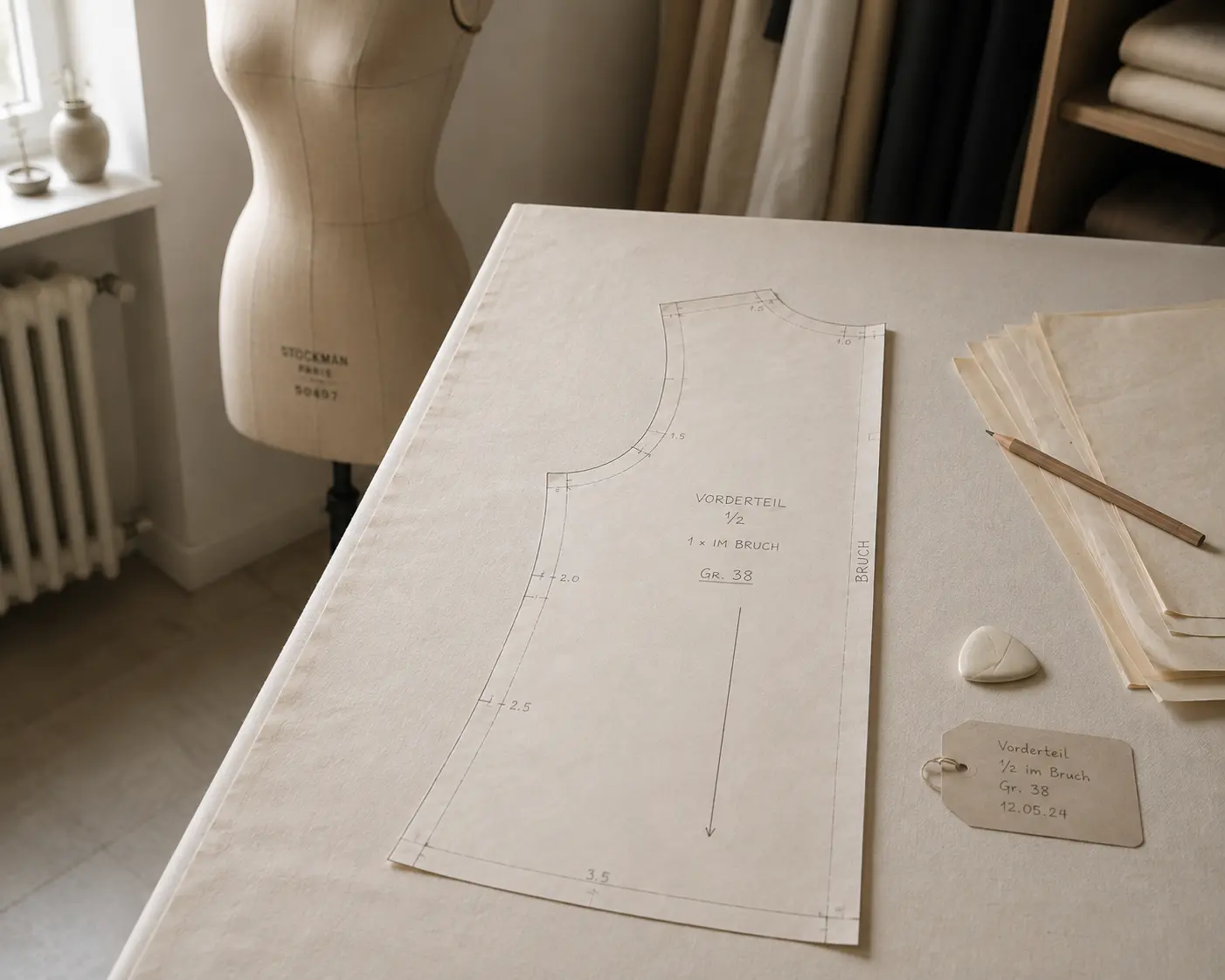
On a holiday snapshot nobody notices. On a pattern piece it lands directly in the measurements, because the parts of the piece near the edge of the frame are rendered at a different scale than the middle. A long side seam is exactly the case where a small curve turns into a real deviation in millimetres.
Filling the frame with the piece, holding the camera parallel to the surface and shooting from directly above all reduce the effect but do not remove it. Removing it needs the optical properties of that specific camera, which is what a calibration profile holds.
Lens distortion and perspective are two different errors. Straightening a photo by dragging its corners corrects the angle but leaves the curve of the lens untouched.
Digitize sewing patterns without tracing.
Test PatternScan Pro free for 14 days with the full feature set. You need your smartphone, a printer and one pattern you always wanted digital.
Photograph your paper pattern and get an automatically scaled digital version with PatternScan Pro.
Usage
.svg)