
Our interview at Europe's largest trade fair for crafts (Full Interview)
Our recap of h+h cologne 2026: conversations with users, new ideas for the app and our interview in the Talk Zone about pattern digitization and the future of handcraft in fashion design.

Rasmus Liebscher
Co-Founder & Developer
Update, September 2026: This interview is from March 2026 and some answers describe the state back then. Since June, PatternScan Pro uses Reference Tiles instead of the checkerboard (see our update post), notches, seam allowances and the grain line are in the editor (guide), and the mobile app we talk about exists now for iPhone and Android.
h+h cologne 2026 is behind us. And we’re still full of impressions.
Last year we came to the trade show for the first time, as visitors. We barely knew anyone, had an app that was far from finished, and simply wanted to understand: are there people who need what we’re building? The answer was yes. That meant a lot to us.
This year felt a little different.
Conversations, Feedback and New Ideas
What excites us most about h+h cologne is the people we meet. We talked with people who are already using PatternScan Pro, with people who want to try it, and with many who were simply curious.
The feedback was honest and direct, exactly what we need. What made us particularly happy was that users came with very concrete ideas for how the app should develop.
Two topics kept coming up. One is support for notches, grain lines and darts directly in the app, so not just the outline of a pattern piece but all the information that’s actually on a sewing pattern. The other is the question of how to take better photos. We have an idea for this: a mobile app, similar to scanner apps for phones, that helps you take the photo, shows the right distance and warns you when light reflections might affect pattern detection.
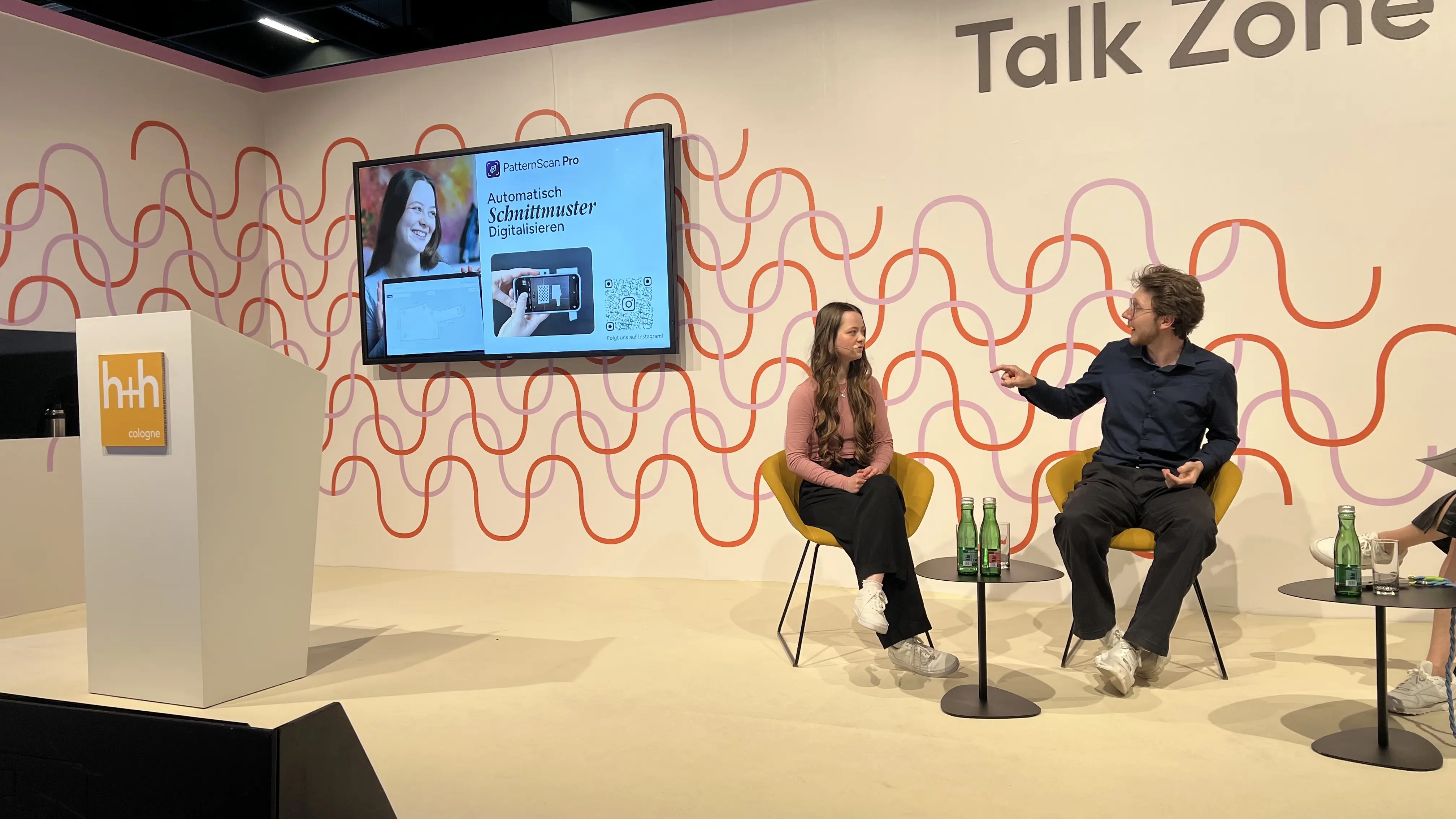
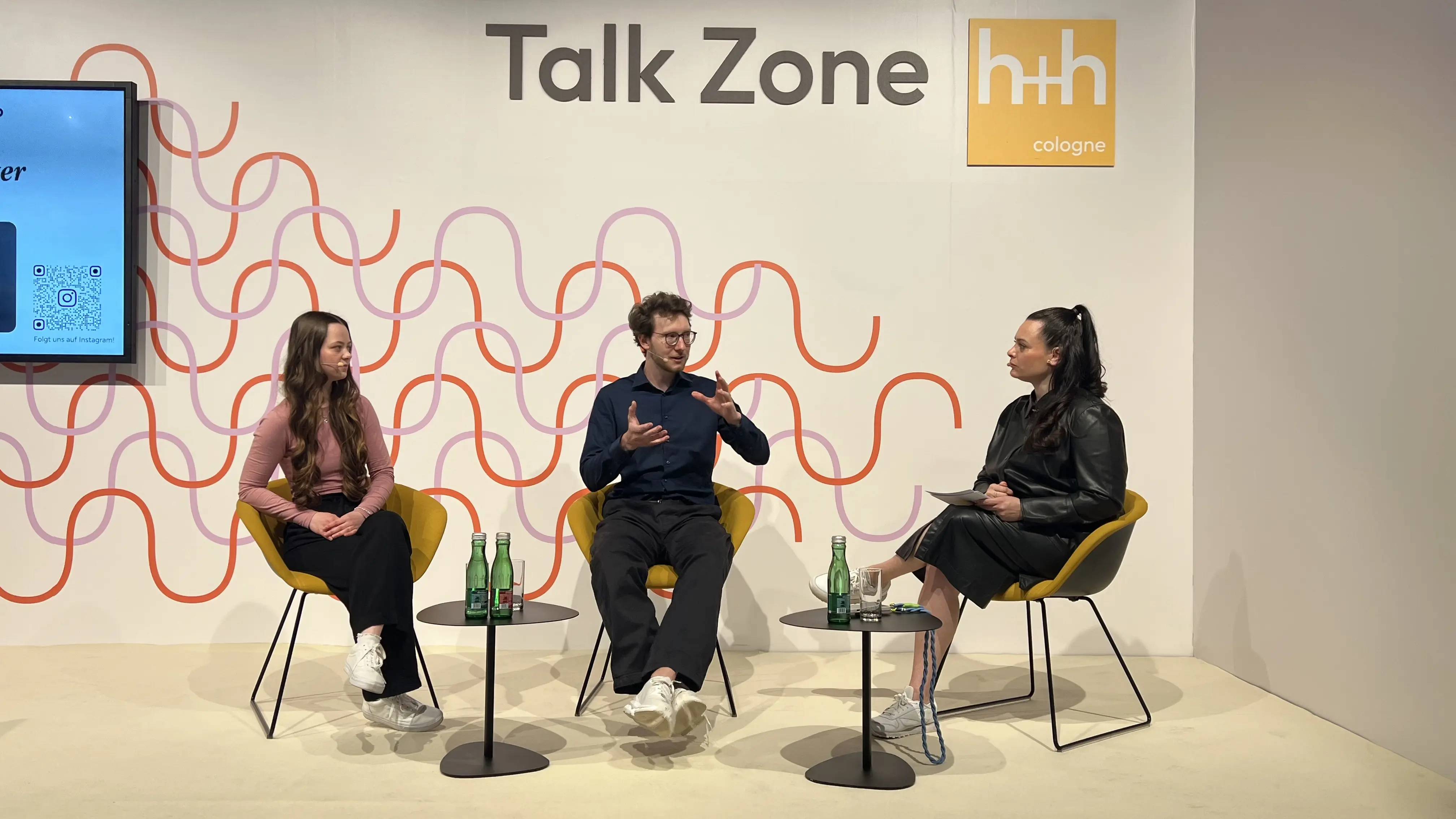
Our Highlight: The Interview in the Talk Zone
The highlight of the trade show for us was a special moment in the Talk Zone. We were invited to give an interview and talk about our story: the idea behind PatternScan Pro, the difficult moments, and what drives us. We also talked about how we hope our tool can help creative people draft their own patterns — and in doing so, push back confidently against AI-generated patterns.
For everyone who wasn’t there, we’ve written out the full interview below. Enjoy reading it. And if you have questions about us or the app, feel free to reach out directly by email at mail@patternscan-pro.com.
Interview: 12 Months, 3 Crises, 1 App
Maren is studying fashion design at HTW Berlin in her 5th semester and loves everything creative with her hands, whether that’s knitting, crocheting, painting, crafting, or of course sewing. Rasmus is studying service design at master’s level, also at HTW. During his bachelor’s degree he focused intensively on product development and user-centered design. Together they run the YouTube channel “Nähen mit Maren” and developed PatternScan Pro.
You make sewing tutorials on YouTube and sell sewing patterns, and then you developed your own app. How did that come about?
Maren: We started making YouTube videos in English three years ago, then switched to German about a year and a half ago. Even with the English videos, we quickly noticed how valuable it was to be able to offer sewing patterns alongside the tutorials.
I found it so exhausting to digitize my hand-drafted patterns. Tracing in Illustrator is manageable, but correcting distortion, scaling — that just takes a long time and isn’t really the part that’s fun.
Rasmus: And then Maren talked to me about it, and since I had just finished my bachelor’s degree, I was keen to take it on. There really isn’t a good solution for digitizing sewing patterns at home.
For everyone who doesn’t know PatternScan Pro yet: what does the app do, and how does it work?
Rasmus: Our tool takes an existing process and simplifies it radically. To digitize hand-drafted patterns from paper or muslin, you used to have to take a photo, for example on a cutting mat. That photo then needed to be corrected for distortion, scaled to the right size, and manually traced before it could be used digitally.
Alternatives are large-format scans at copy shops, but the patterns need to be traced out first. Or large scanning tables. Neither is practical for small studios or home use.
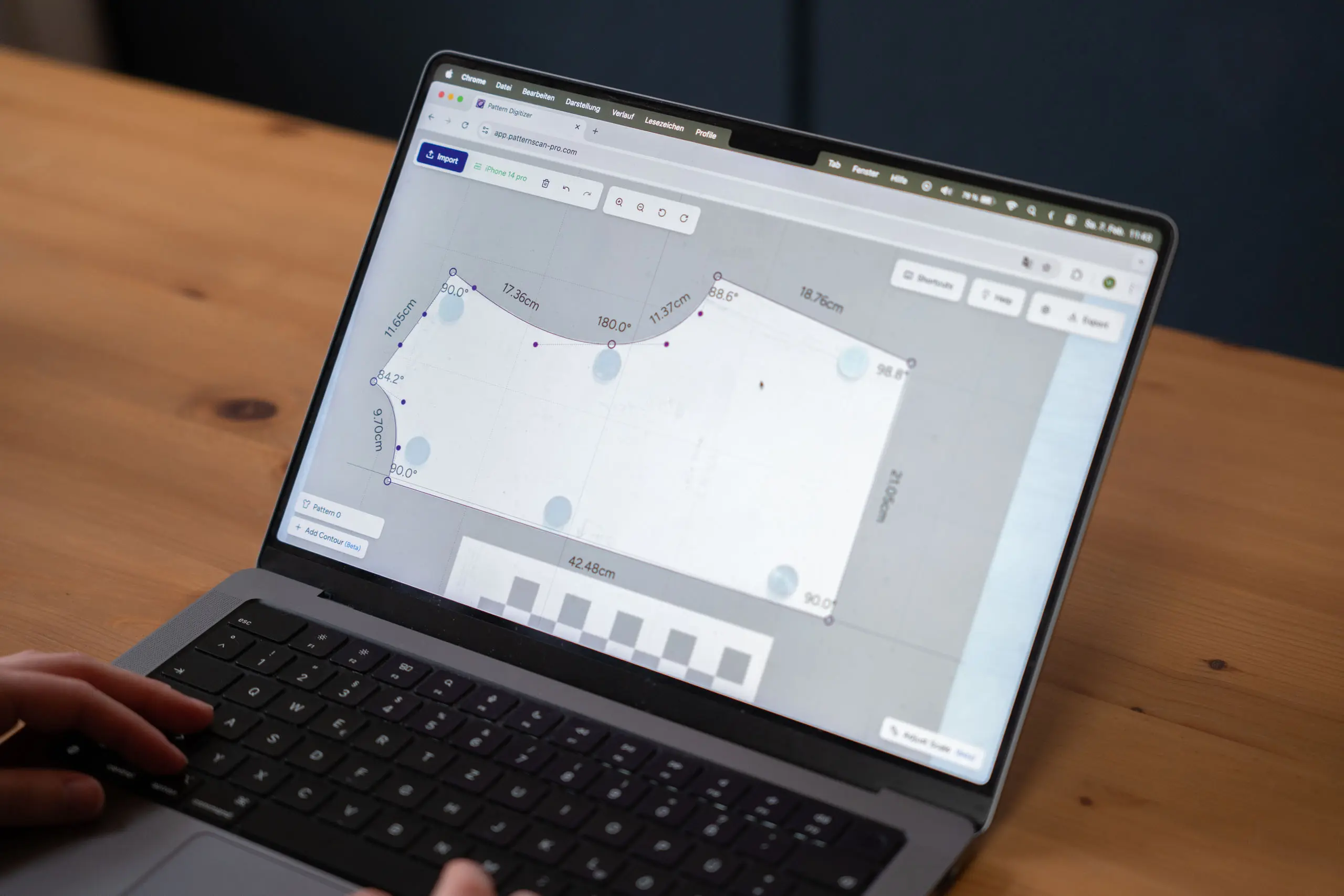
PatternScan Pro does all of this automatically: you photograph your pattern piece, the app detects the contours, corrects the distortion, scales it, and you can export directly for CLO3D, Illustrator or CAD software.
From the first prototype to today: what surprised you the most?
Rasmus: The complexity. At the start I genuinely thought this would be straightforward. But detecting pattern pieces turned out to be far more demanding than expected.
Detecting a light pattern on a dark background is still relatively easy. It gets difficult at the point where you have to define criteria for where points, lines and curves are. The simplest approach would be to represent the contour through thousands of points — that’s just vectorization and takes one click in Illustrator. What makes our app special is that it makes a decision upfront: what should be straight lines, what should be curves, and where are the corner points. That’s what makes editing quick.
You’re building a technical product for creative people. How do you make sure the technology doesn’t get in the way?
Maren: The app is completely reduced. We don’t think: could this need another feature, or could there be another button here. Everything in the interface has to earn its place. We believe that clarity is strength. Our tool should fit into the workflow of creative people and not be yet another tool you have to “learn.”
Rasmus: Our design and development process is 100% user centered. Maren is the user, and it’s rare to be able to do software development in such close collaboration.
What was the hardest moment so far, and what kept you going?
Rasmus: The app uses a checkerboard pattern to correct perspective and scale. I had been checking digitally against the reference whether the scaling and distortion correction was working. Then a test user got in touch and said she’d measured the pattern piece and the dimensions were simply wrong.
That’s when we realized there was another source of distortion: lens distortion from the camera that we hadn’t accounted for. It was being “corrected” at the reference point but not across the whole image. We’ve since found a good solution with a calibration profile, but that was a real shock.
There’s no guide for how to build an app for pattern digitization. We had to figure everything out ourselves, and sometimes it was genuinely tricky. Another difficult moment was when we reached out to pattern designers on Instagram looking for testers, and it seemed like everyone was doing everything digitally and wanted nothing to do with paper.
Thankfully we now have enthusiastic users who give us the confidence that this is a real use case and that there is genuine interest in digitizing sewing patterns, even in 2026. We were just probably looking in the wrong place for the right audience.
Your vision is to bridge analog and digital workflows. What do you mean by that exactly?
Maren: There’s a trend toward creating DIY sewing patterns entirely digitally, to develop patterns as efficiently and easily as possible. This often means starting from a base block and modifying a few things. That has its place, especially for basic pieces. But it doesn’t produce anything new.
We think there should be more freedom in design, to create something original, and that’s only partly possible on a computer. My conviction is that creativity happens through doing: through drawing, draping and sewing, not through clicking on a computer. And anyone who has tried to arrange beautiful folds in a 3D program knows that it’s a much more intuitive and natural process on a dress form.
Ultimately, a pattern needs to be digital for professional use: for grading, for further processing, and for selling if it’s a DIY sewing pattern. And that’s exactly where we want to be the bridge, between real handcraft and the digital world.
Digitization is often seen as a replacement for handcraft. You see it differently. Why?
Maren: Nobody wants an AI-prompted sewing pattern or design that may not even have been tested. There are countless guides online for how to spot AI-generated patterns in order to avoid them.
We see that less and less is being made by hand out of efficiency, and more and more is done purely digitally. Our approach isn’t to put our heads in the sand and accept that that’s just how it is. Instead, we’ve built a solution that connects handcraft and digital tools so the best of both worlds is possible. We don’t want to replace handcraft, we want to protect it.
What’s coming next, what can we look forward to?
Rasmus: The app is constantly in development. Specifically I’m working right now on supporting not just the outlines of pattern pieces, but also notches, pocket markings, grain lines, darts and so on.
We’re also constantly gathering feedback from users to improve things, both how they function and how they’re explained, to keep simplifying the process.
What we still see as the biggest challenge is taking the photos. We’re currently planning a mobile app that helps with that, similar to scanner apps for phones. It would alert you when you’re at the right distance, or warn you if light reflections are likely to affect detection.
If someone is thinking “that could be for me,” how do they get started?
Maren: We have a free trial period, so there’s really no reason not to just try it and see if it’s for you.
And we’d love to talk with anyone who’s interested, answer more questions. And anyone who wants to can of course try the app directly.
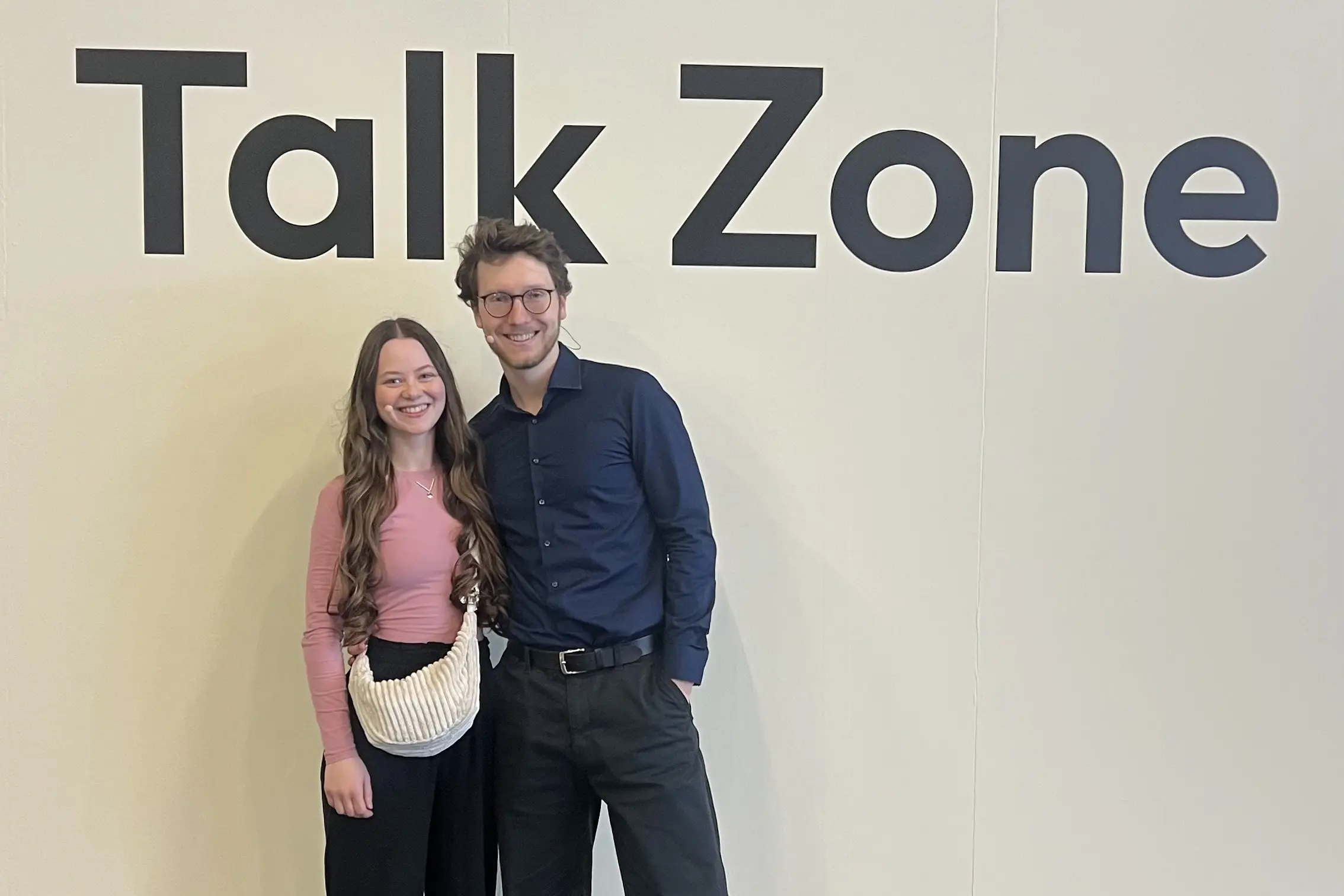
Thank You h+h, See You in 2027!
We’d like to say a big thank you to h+h cologne for the invitation and the opportunity to tell our story on stage.
Last year, at our first visit, PatternScan Pro wasn’t publicly available yet. We had an idea, a prototype and a lot of open questions. This year we have users, real-world feedback, and a much clearer picture of who uses the app and why.
We’re already curious to see where we’ll be when it’s time for h+h cologne 2027.
Want to try PatternScan Pro? Test it free for 14 days with the full feature set. Questions? Reach out on Instagram @patternscanpro.
Rasmus is Co-Founder of PatternScan Pro and develops the app with a focus on precision and intuitive usability.
Digitize sewing patterns without tracing.
Test PatternScan Pro free for 14 days with the full feature set. You need your smartphone, a printer and one pattern you always wanted digital.

Photograph your paper pattern and get an automatically scaled digital version with PatternScan Pro.
Usage